
 Postural
Assessment and Education
Postural
Assessment and Education
The skeleton is viewed as a series of building blocks piled one on top
of the other, starting with the bones of the feet and ending with skull.
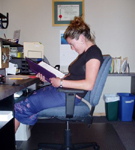
A postural assessment begins with an observation of an individual's spinal
alignment in relaxed standing. The assessment can progress to observation
of spinal alignment in sitting, during activities of daily living and
sports. Alteration in joint position, a change in muscle function either
due to spasm or weakness, tightness or laxity of ligaments, and shortening
or lengthening of connective tissue are all considered when doing a postural
assessment.
Correction of postures that vary from normal, non-stressful positions
is directed toward restoring maximal motion to all joints, symmetry of
length and strength to all muscles and ligaments, and symmetry of connective
tissue tensions relieving restriction and pain throughout the body. This
restoration is attempted through education, such as bringing awareness
to a poking chin posture. The prescription of specific exercises, like
lower trapezius strengthening are essential for attaining proper postural
alignment.