
THE
DEAL ABOUT FASCIA
By Bob Fong
Fascia is a connective tissue in your body that forms an endless web
and acts as your body’s shock absorber. The fascial system separates,
supports, and connects all of your body’s tissues including muscles,
bones, nerves, blood vessels, and organs. Fascia, literally, connects
your head to your toes and your core to your periphery. In addition,
the fascial system transforms muscle contraction into organised movement
whether you are sitting at the computer (postural) or playing hockey
(dynamic movement).
The fascial system is a true whole-body communicating system.
An injury or trauma to one part of your body can affect any other part
via the multi-directional fascial connections, particularly with injuries
involving an extrinsic force. These forces may include a backwards fall
onto the pelvis, any injurious contact in sports, or any forces absorbed
by your body during a car accident. The fascial system distributes these
mechanical forces (tension and compression) throughout your body. Similarly,
any restriction in your body, like a snag in a sweater, is spread across
your entire fascial web.
Due to the vastness of the fascial web, an injury in one area can also lead to strain, tension or fixation away from the painful site. The impact from a backwards fall onto your pelvis can affect the entire system but may initially cause localized pain in your lower back region. Later, there may be subsequent problems in your upper back region that seem unrelated to the fall. In this case, unless the fascial connections between the pelvis and the upper back are addressed, the pain and restriction patterns will continue.
Abnormal points of tension or restrictions within your fascial system will force your body to move in different ways because of your body’s numerous mechanisms for adaptation and compensation following an injury. Your body will naturally follow the movement path that is easiest and least painful. This adaptation or compensation can lead to poor movement patterns, muscle imbalances, postural problems, joint irritations, and eventually pain.
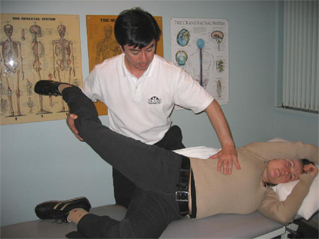
Techniques used to treat fascial restrictions include Myofascial Release Therapy and whole-body stretching. Myofascial refers to the bundled, inseparable nature of muscle tissue (myo-) and its accompanying web of connective tissue (fascia).
Practitioners of myofascial release use a gentle hands-on manipulation
of the entire body to gradually soften, lengthen and realign the fascia.
Fascial restrictions respond best to slow sustained stretching (up to 2-3
minutes) with the addition of gentle movement and specific body positioning.
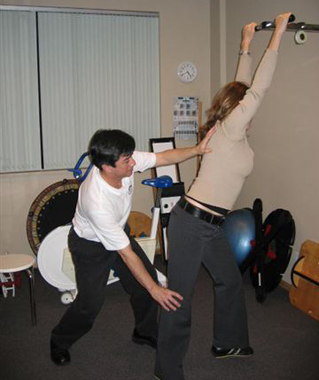
Whole-body stretching involves the connection of different body regions rather than just isolated stretches. Many yoga poses (asanas) incorporate the concepts of whole-body stretching such as the triangle and warrior poses. These positions can provide the basis for individual needs and gentle release. This type of stretching can be particularly useful for the trunk, spine, hips and shoulder girdle.
In conclusion, having knowledge of fascial connections and of whole-body patterns will offer another layer of understanding to the assessment and treatment of acute injuries and chronic painful patterns when working with your physiotherapist and personal trainer.